Driveway Care
Driveway Grading in Ontario: Slope, Drainage and Cost
Quick answer: Driveway grading is shaping the ground and base so water runs off instead of sitting on or under the pavement. In Ontario, aim for a steady fall of at least 2% away from the house, with local standards such as Kawartha Lakes’ capping driveways around 7%. Bad grading lets water into the base, and freeze-thaw does the rest.
A lot of the driveway failures we see in the Kawarthas are not really about the asphalt. They are about water. This guide covers driveway grading: what slope to aim for, how a poor grade damages a driveway through our freeze-thaw winters, and what it costs when it is wrong.
Contents
- What Is Driveway Grading and Why Does It Matter?
- What Slope Should a Driveway Have in Ontario?
- How Does Poor Driveway Grading Damage Asphalt?
- What Does a Bad Grade Cost You?
- How Can You Check Your Own Driveway Grade?
- How Do We Handle Grading on a Paving Job?
- Key Takeaways
- FAQ
What Is Driveway Grading and Why Does It Matter?
Driveway grading shapes the ground so water runs off. It happens before any asphalt goes down, when the old surface is out and the base is being built. A driveway with the right grade sheds water on its own, and a flat or backwards one holds it.
Water matters because the soil and stone under asphalt behave very differently wet and frozen. If water has somewhere to go, the base stays firm. If not, the base turns soft in spring and heaves in winter, and grading is cheap to get right and costly to fix later, so we treat it as part of the asphalt paving process.
Grade is a percentage. A 2% slope drops 2 cm over every metre. Over a 10 metre driveway, that is 20 cm from the high end to the low end, which sounds like a lot until you see how gentle it looks.
What Slope Should a Driveway Have in Ontario?
Aim for 2% to 7%, sloping away from the house. No single provincial figure covers a homeowner’s driveway, because municipalities set their own standards. The two below are written for new lots and entrances, but they are a sound benchmark for any driveway, including a driveway slope check on yours.
| Standard | Min grade | Max grade |
|---|---|---|
| City of Kawartha Lakes lot grading guidelines | 2.0% | 7.0% (8.0% only in exceptional cases) |
| Township of Oro-Medonte entrance standards | 2% | 7% on private land, not recommended unless the site forces it |
- Kawartha Lakes: at least 2.0% positive drainage away from any building, and driveways must not be used as outlets for swales.
- Oro-Medonte: driveways sloping down to the garage are actively discouraged; where used, 2% positive slope from the garage for at least 7 m.
Both standards want water moving away from the building, and both treat the top end as a last resort. A steep driveway is harder to plow, harder to climb with ice on it and harder to compact while it is built.
Check with your own township or city before relying on a figure. These are design guidelines for new construction, not a rule for repaving, but they show what local engineers consider normal.
How Does Poor Driveway Grading Damage Asphalt?
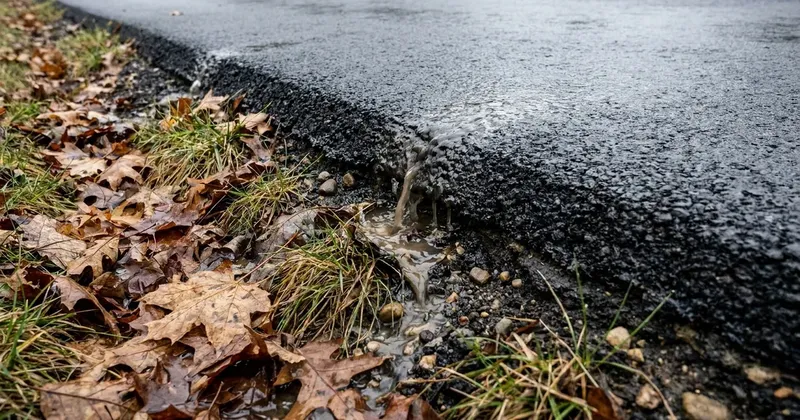
Standing water gets into the base, and frost does the rest. Water expands as it freezes, so it lifts and breaks the surface from underneath. Every freeze-thaw cycle repeats the damage, and the cracks it opens let in more water the next time.
These are the grading problems we see most often:
- Flat spots. Puddles sit on the surface and soak into every crack.
- Backwards slope. Water runs toward the garage or house and pools at the door.
- Low corner with no outlet. The driveway drains to a spot the water cannot leave.
- Neighbouring runoff. A swale, downspout or ditch dumps onto the pavement. Kawartha Lakes guidelines say driveways should not be used as swale outlets and that downspout discharge belongs on a splash pad, not a driveway.
- Edges higher than the lawn. Water collects along the edge and undermines it.
The result is the damage we describe in our guide to frost heave and driveway potholes: ripples, sunken spots, spreading cracks and a crumbling edge. A thick asphalt layer cannot make up for a base that stays wet.
What Does a Bad Grade Cost You?
It costs you driveway lifespan and repeat repairs. We will not quote a price here, because we have not seen your lot and a made-up number helps nobody. Costs depend on the lot, the base and how much water needs somewhere to go, so here is where the money goes.
- Repeat repairs. Patching a pothole that water keeps reopening is paying for the same job each spring.
- Shorter surface life. Paving over a bad grade puts a new surface on the same problem.
- Water at the house. A driveway that drains toward the foundation or garage can cause damp and ice problems that cost far more than the driveway.
- Extra work at paving time. As we explain in our post on what goes into your asphalt driveway cost in Ontario, a driveway that holds water or drains toward the house needs correcting during the pave, and steep or sloped properties take more equipment time.
The honest summary is that fixing the grade while the driveway is already open costs far less than fixing it after the asphalt is down. When you compare quotes, ask each contractor how they will handle drainage. If the answer is vague, expect a vague result.
How Can You Check Your Own Driveway Grade?
A straight board and a level give a rough check. It will not replace a proper survey, but it tells you whether the problem is worth a call. Do it after rain, when the low spots are easy to see.
- Walk the driveway after a heavy rain and note where water sits for more than a few hours.
- Lay a straight board along the driveway, start at the garage and level one end. A 1 metre board with a 2 cm gap under the low end means roughly 2%.
- Check the first few metres from the garage. This is the section that matters most, and it should fall away from the door.
- Look at where the downspouts, sump discharge and lawn slope end up. They should send water off the pavement, not onto it.
- Check the edges. Grass or gravel sitting higher than the asphalt traps water along the side.
- Photograph anything that looks wrong, so a contractor can see it in context.
If water sits on the driveway, or runs toward the house, the grade needs a professional look before any new asphalt is laid.
How Do We Handle Grading on a Paving Job?
We check where the water goes before we price. At Harwick Paving, grading and driveway drainage is a step in every driveway we build: the old surface comes out, the site is shaped so water runs off and away from the garage and foundation, and then the base goes in and is compacted.
When we come out to quote, we walk the lot with you. We check the existing slope, where the water leaves and whether soft spots need digging out. If the base needs reshaping, we say so, because we would rather you hear that at the quote than see puddles in April.
We pave residential driveways, repair and resurface worn asphalt, and take on commercial and industrial work across Cannington, Lindsay, Bobcaygeon, Fenelon Falls and Peterborough. See our paving services, or call 705-341-4113 to book a free on-site quote.
Key Takeaways
- Driveway grading is shaping the ground and base so water runs off the pavement and away from the house, and driveway drainage is the result.
- Aim for at least 2%, with local standards such as Kawartha Lakes’ capping driveways at about 7%.
- Slope away from the garage and foundation, never toward them.
- Standing water plus freeze-thaw is behind many early cracks, heaves and potholes.
- Fixing the grade while the driveway is open costs far less than fixing it afterward.
- Ask every contractor how they will handle drainage before you compare prices.
FAQ
What is the best slope for a driveway?
Aim for a gentle, steady fall of at least 2% away from the house, which is about 2 cm of drop for every metre of length. The City of Kawartha Lakes guidelines use 2% as the minimum and 7% as the usual maximum for driveways. Anything steeper gets hard to plow and hard to stop on in winter.
Should a driveway slope toward the garage or away from it?
Away from it. Both Kawartha Lakes and Oro-Medonte standards call for positive drainage away from the building, and Oro-Medonte actively discourages driveways that slope down to the garage. Water that runs toward the door ends up at the foundation, and in winter it freezes into a sheet of ice at the threshold.
Can you fix a driveway that drains the wrong way without replacing it?
Sometimes. Minor low spots can be filled or cut out and patched, but a driveway that is graded the wrong way across its whole length usually needs the surface lifted and the base reshaped. A contractor has to see the lot to say which applies, because the answer depends on where the water can go once it leaves the pavement.
Does poor driveway grading cause cracks and potholes?
Yes. Water that sits on or under the asphalt gets into cracks and soaks the base, and when it freezes it expands and the surface lifts and breaks. Poor drainage is one of the usual reasons a driveway fails early, even when the asphalt itself was laid well.
Do I need a permit to regrade my driveway in Ontario?
It depends on your municipality. Many have lot grading rules that stop you from sending water onto a neighbour’s property or changing the approved drainage pattern, and entrance work near the road can need approval. Check with your township or city before changing grades near the road or property line.
Get a Free Driveway Quote
Harwick Paving serves Cannington, Lindsay, Bobcaygeon, Fenelon Falls, Peterborough and Sunderland. We will look at your slope and drainage, explain what the lot needs and give you a free, no-obligation quote. Call 705-341-4113 or request your quote online.